Baked goods
How many grams is a cup of flour, a tablespoon of sugar or a stick of butter? Choose an ingredient and a measure – the conversion to grams and back appears right away. We use the same weights as for the nutrition facts of our recipes.
All-purpose flour: 1 cup (US, 236.6 ml) = 132 g.
Weight of one measure for 40 common ingredients. Cups are US cups (236.6 ml), a tablespoon (tbsp) 14.8 ml and a teaspoon (tsp) 4.9 ml; the metric cup of our recipes has 250 ml. Click an ingredient to open it in the converter above.
| Ingredient | 1 cup | 1 tbsp | 1 tsp | 1 metric cup |
|---|---|---|---|---|
| Flour and grains | ||||
| All-purpose flour | 132 g | 9.9 g | 3 g | 140 g |
| Semi-coarse wheat flour | 137 g | 12 g | 3.9 g | 145 g |
| Coarse wheat flour | – | 13 g | 3.9 g | – |
| Spelt flour | 118 g | 9.9 g | 3 g | 125 g |
| Whole wheat flour | 120 g | 7.9 g | 3 g | 127 g |
| Fine wheat semolina | 175 g | 12 g | 3.9 g | 185 g |
| Rolled oats | 80 g | 4.9 g | 2 g | 85 g |
| Rice | 185 g | 12 g | 3.8 g | 195 g |
| Breadcrumbs | 108 g | 6.9 g | 2.5 g | 114 g |
| Cornstarch | 128 g | 9.9 g | 3 g | 135 g |
| Sugar and sweeteners | ||||
| Granulated sugar | 200 g | 13 g | 3.9 g | 211 g |
| Superfine sugar | 199 g | 13 g | 4.1 g | 210 g |
| Powdered sugar | 120 g | 7.9 g | 2.5 g | 127 g |
| Cane sugar | 189 g | 13 g | 4.4 g | 200 g |
| Honey | 336 g | 21 g | 6.9 g | 355 g |
| Maple syrup | 312 g | 20 g | 6.9 g | 330 g |
| Fats | ||||
| Butter | 218 g | 14 g | 4.9 g | 230 g |
| Vegetable oil | 218 g | 14 g | 4.5 g | 230 g |
| Olive oil | 218 g | 13 g | 4.4 g | 230 g |
| Lard | 213 g | 13 g | 4.2 g | 225 g |
| Milk, cream and liquids | ||||
| Water | 237 g | 15 g | 4.9 g | 250 g |
| Milk | 244 g | 15 g | 4.9 g | 258 g |
| Heavy whipping cream | 237 g | 15 g | 4.9 g | 250 g |
| Sour cream | 237 g | 15 g | 4.9 g | 250 g |
| Plain yogurt | 241 g | 15 g | 4.9 g | 255 g |
| Cooking cream | 238 g | 15 g | 4.9 g | 252 g |
| Rum | 222 g | 14 g | 4.6 g | 235 g |
| Baking ingredients and spices | ||||
| Cocoa powder | 85 g | 5.9 g | 2 g | 90 g |
| Baking powder | – | 14 g | 4.5 g | – |
| Baking soda | – | 14 g | 4.5 g | – |
| Vanilla sugar | – | 12 g | 3.9 g | – |
| Active dry yeast | – | 12 g | 3.9 g | – |
| Ground cinnamon | – | 7.7 g | 2.6 g | – |
| Salt | – | 18 g | 5.9 g | – |
| Sweet paprika | – | 6.7 g | 2.3 g | – |
| Black pepper | – | 6.8 g | 2.3 g | – |
| Nuts, poppy seeds and coconut | ||||
| Ground nuts | 85 g | 5.9 g | 2 g | 90 g |
| Ground poppy seeds | 118 g | 6.9 g | 2.5 g | 125 g |
| Almonds | 132 g | 8.9 g | 2.8 g | 140 g |
| Shredded coconut | 76 g | 5.9 g | 2 g | 80 g |
Average weights of pieces and packages. Packages in our recipes are Central European sizes (for example baking powder 12 g, vanilla sugar 20 g, a block of butter 250 g); check the exact weight on the pack.
| Ingredient | Measure | Weight |
|---|---|---|
| Butter | 1 stick | 113 g |
| Butter | 1 block | 250 g |
| Fresh yeast | 1 cube | 42 g |
| Active dry yeast | 1 packet | 7 g |
| Baking powder | 1 packet | 12 g |
| Vanilla sugar | 1 packet | 20 g |
| Pudding mix | 1 packet | 40 g |
| Gelatin | 1 packet | 20 g |
| Gelatin | 1 gelatin sheet | 1.7 g |
| Sour cream | 1 tub | 200 g |
| Plain yogurt | 1 tub | 150 g |
| Quark | 1 tub | 250 g |
| Eggs | 1 egg | 50 g |
| Egg yolks | 1 egg yolk | 17 g |
| Egg whites | 1 egg white | 33 g |
| Lemon juice | juice of 1 lemon | 40 g |
A cup is a measure of volume, not weight. Dry ingredients have different densities and there is air between the grains, so a cup of granulated sugar weighs about 200 g, all-purpose flour 132 g, powdered sugar 120 g and cocoa only 85 g. Liquids are closer to water: a cup of milk weighs 244 g, oil 218 g (oil is lighter than water) and honey as much as 336 g. That is why a recipe in cups cannot be converted with one number – each ingredient has to be converted separately.
Our recipes come from Slovakia. Old Slovak recipes count in dekagrams (1 dkg = 10 g, so 25 dkg = 250 g), in a “mug” of about 250 ml and in deciliters (1 dl = 100 ml). In the translated recipes we give grams and milliliters, and for oven temperatures °C with °F.
The weights of one measure are average values that we also use for the nutrition facts of the recipes on this website. Milliliters and fluid ounces of dry ingredients are calculated from the weight of a cup. The real weight depends on how you fill the measure, so the numbers are approximate – for doughs where precision matters (sponge cake, yeast dough, macarons) we recommend a kitchen scale.
A different pan size than in the recipe? Use the baking pan converter. The calories of your own recipe are worked out by the recipe calorie calculator.
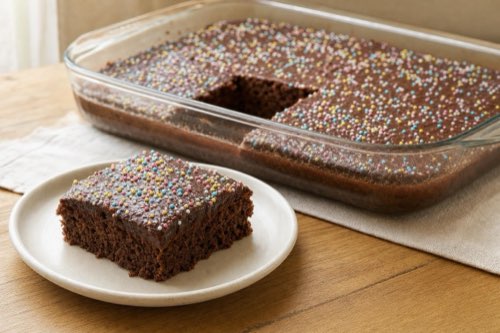
Cakes where you do not need a scale – everything is measured with one cup or mug.